Wednesday, 30 January 2019

2.5D Platformers

Sonic Rush
Sonic Rush is a 2.5D platformer released for the Nintendo DS in 2005 developed by Dimps. It was the game to introduce the boost system to the series, which would later be brought back in Sonic Unleashed. It's often referred to as a spiritual successor to the GBA games, Sonic Advance.

Image result for sonic rush


Mighty No 9

Mighty No 9 was a kickstarter project from 2016 by Level-5 Comcept, which was funded $4,069,579. It was advertised as a spiritual successor to Mega Man, and even had the character designer of Mega Man, Keiji Inafune, work on the concept art.
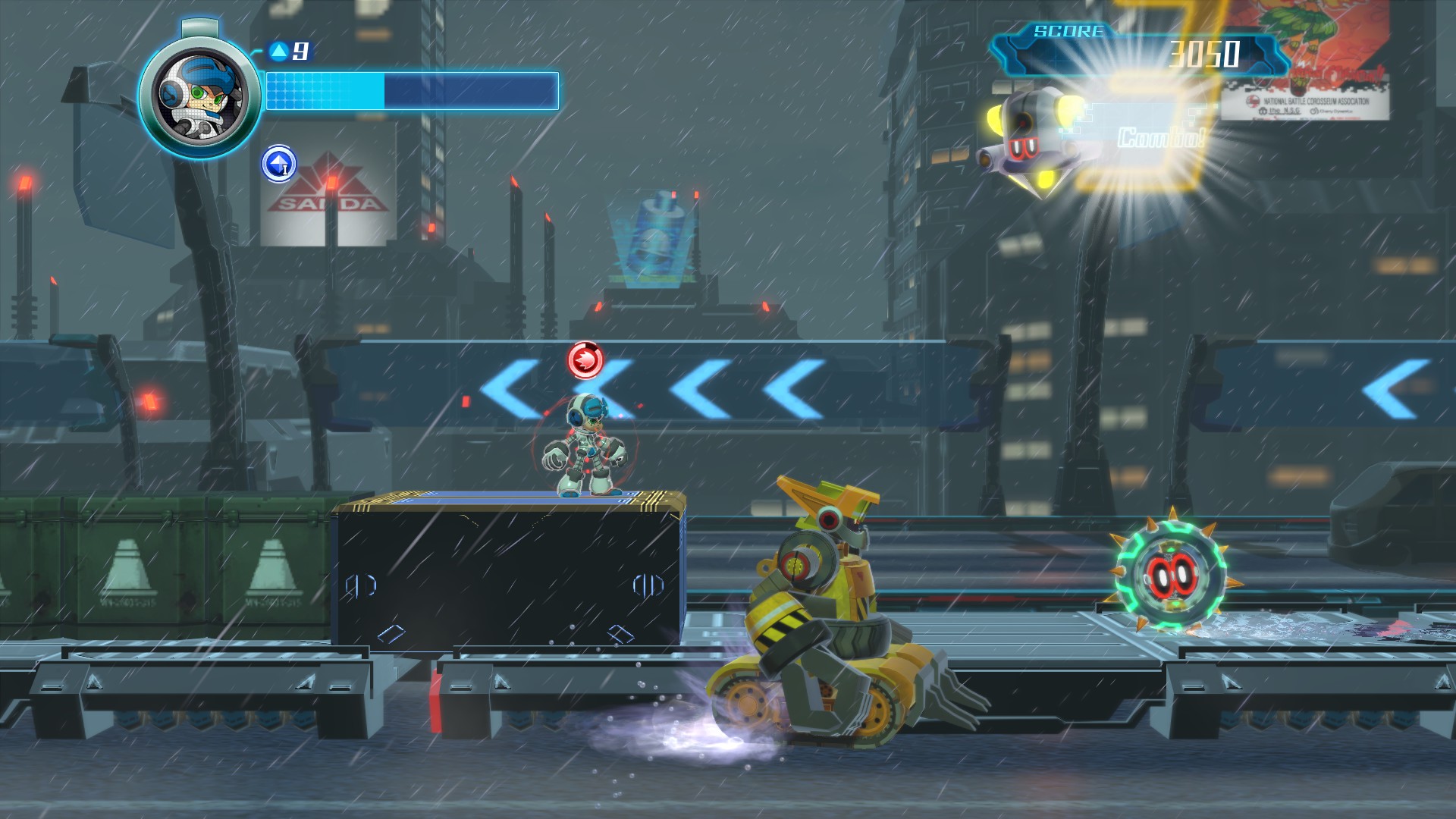
Image result for mighty no 9

Prices

The price of Sonic Rush at launch can't be found, however I'm assuming it must of been £20-£30, like the price of most DS games at launch. However now it can be found for just around/under £10 from most places, such as CEX. Mighty No 9 costs £15.99 on digital stores, and around/under the same price in physical form.

Target Audience

Sonic Rush had a wide target audience. It was aimed at fans of both the main series, and fans of the Sonic Advance games on GBA, and the fans of the classic Sonic games with the special stages. It was also aimed at almost anyone, since it was easy to pick up and play. The target audience for Mighty No 9 was also aimed at anyone, but classic Mega Man fans in particular, since it was a spiritual successor, and had parts of the original developers working on it too, such as the soundtrack composer, and the previously mentioned character designer.

Platforms
Sonic Rush was released as an exclusive to the DS. However, it can be played on 3DS through backwards compatibility, and PC/mobile through emulation. Whereas Mighty No 9 was released for a wide range of consoles:Windows, PS3, PS4, Wii U, Xbox 360 and Xbox One. However, it was also supposed to release for 3DS and PS Vita, which it still hasn't. They were said to release at the end of 2017, and there still hasn't been any updates. They weren't cancelled, and the 3DS version is still available to pre-order on Amazon.

Reviews 
Sonic Rush was received a lot of positive reviews, and was the ninth best selling DS game in 2006. It received a Platinum sales award, meaning it sold over 300K copies in the UK. It was praised for its "gorgeous graphics" and for its soundtrack, composed by Hideki Naganuma, who also composed Jet Set Radio's soundtrack. It was ranked #17 in IGN's top 25 best DS games.

Mighty No 9, on the other hand, received average reviews, with the Wii U version getting the worst reviews due to technical issues. It was called "charmless" and had "poorly executed ideas". There was apparently too much content recycled, copy and paste designs and failed to entertain. It continued to receive more bad reviews due to the constant delays. It was originally announced in 2013, but got pushed back to 2016. The Xbox 360 version was pushed back a day later than the other versions. The game was considered a scam, considering how much is lacked for the amount of money it was funded, and not receiving the PS Vita and 3DS versions, which still haven't been released to this day.

Thursday, 17 January 2019

Game Engines

Purpose
Game engines are used to build video games. Their purposes are that they provide a suite of development tools. For simplified and rapid development, the tools are usually provided in an IDE (Integrated Development Environment). Game engine developers try to develop robust software which includes many elements that are required to build a game. Most game engines include graphics, sound, physics and AI functions. Sometimes these engines are called "middleware" because of the flexible and reusable software they provide the required core functionality. This helps with the critical factors in the video game industry. They feature tools such as renderers, animation and scripting, and programming languages such as Java and C++. A game engine's purpose is to give the developer(s) a wide range of tools for production

Examples of game engines 
Some examples of game engines are:
Unreal Engine
Construct 2
Frostbite

The constraints
Unreal Engine
 Polygon count - The polygon count for Unreal Engine depends on how many models are in the game at once. If you don't have many characters in your game, the recommended polygon count is around 30k, whilst that would be too much if you have over 50 characters.
 Real time rendering - Unreal Studio has a tool called Sequencer. It is used to create cinematics and videos with the game.
 Hardware - Unreal Engine started off as an engine for PC, until Unreal Tournament for PS2 and Dreamcast. UE4 had a rough start on PS4 and Xbox One, however now it works well. Epic Games has began to focus on UE4 for mobile and Switch too.
 LOD's - LOD (Level of Detail) is used to limit the detail of the graphics depending on how far the camera is.
 File size - UE4's file size is 15GB.
 Collision detection - Every model with collision has an 'object type', letting the creator choose whether it can affect, be affected, or none.

Construct 2
 Polygon count - Having a certain number of sprites in a game can cause it to lag and crash.
 Real time rendering - Since Construct 2 is a 2D game creator, it is unable to create real time cinematics.
 Hardware - Construct 2 games can run on PCs through HTML5 and mobile.
 LOD's - The LODs for sprites cannot be altered in Construct 2.
 File size - Unknown
 Collision detection - The sprites have many options for collision.

Frostbite
 Polygon count - Unknown
 Real time rendering - Frostbite Engine uses real time rendering for cinematics.
 Hardware - Frostbite Engine is compatible with PC, PS4 and Xbox One. It's also rumoured that it's getting support for Switch.
 LOD's - Frostbite switches from using LOD to not using LOD for different games.
 File size - Frostibite is currently only available for EA.
 Collision detection - The engine doesn't stop players from walking through the floor/wall. 

3D Modelling Software

There are many software used for 3D modelling. A few examples are Autodesk Maya, Cinema 4D and Blender. Autodesk Maya is a 3D graphics application, used to create assets in films, television, video games and architecture, originally released in 1998 but bought by Autodesk in 2005. Cinema 4D is a 3D modelling, animation, motion graphic and rendering application. It's used for modelling, animating, lighting, texturing, rendering, and other common features found in 3D modelling applications.Currently, there has been 5 variants, and was originally developed for Amiga computers in the early 1990s. Blender is a free open-source 3D computer graphics software, first made in 1995. It is used for creating animated films, visual effects, art, 3D printed models, interactive 3D models and video games. It includes 3D modelling, texturing, sculpting, rendering and much more.

Geometric Theory
Edges - Shows each line that went into making a shape. Certain shapes, such as curved shapes, have a large amount of edges, because they are made up of a large amount of straight lines.
Vertices - Where two edges meet. There will be two vertices on the end of an edge's straight line. Curves need a large amount of edges to be made, and they also need more vertices to be created. They're given coordinates to calculate their exact location.
Polygons - Turns a 3D skeleton into a shape and makes up the surface/faces of the shape. 3 sided shapes are known as trigons (triangle), 4 sided shapes are known as quadrons (square), 5+ sided shapes are known as n-gons (pentagon).
Face - Used for flat surfaces of 3D shapes, and creates the boundaries of the shapes. The faces make up the overall look of the shape. A 3D solid made from flat surfaces is known as a polyhedron.
Co-ordinate geometry:
 2D co-ordinates - The length and width of an object. Needed to create objects at a specific size, and to pinpoint where objects will be placed.
 3D co-ordinates - The length, width and depth of an object. Has more outcomes than 2D co-ordinates. They are important because they can be used to create 3D models and make them into different objects.

Mesh Construction 
Mesh Construction is creating objects with polygon meshes. The polygons are different forms of elements. The elements are the ones in Geometric Theory.
Box Modelling - A primitive shape (e.g. box, cylinder, sphere) is used in the final model as the basic shape.
Extrusion Modelling - Similar to Box Modelling, but is also a lot different. It starts with a single object, and the object is extruded and can be shaped in any way. It isn't able to create complex objects.

Constraints
Polygon Count - Having a certain amount of polygons in a 3D polygon.When creating a model, you need to keep control of how many polygons it has. The amount of polygons could affect how the game runs. Because everyone has different processors in their computers, the polygon count is also different.
File Size - Available in many sizes. The smallest file size can load up the fastest, whereas the biggest file size can hold more polygons.
Render Time - Using a certain render engine will cause a longer loading time.
LOD - Level of Detail. A concept in 3D modelling used to indicate how much detail needs to be modelled.

Tuesday, 23 October 2018

Faults in game soundtrack

Shin Megami Tensei: Nocturne

Shin Megami Tensei: Nocturne is the third main game in the JRPG series Shin Megami Tensei. In my opinion, SMT Nocturne has a very good soundtrack. The only flaw is that in-game, the quality of the soundtrack is heavily downgraded. The reasons for this are unknown, and high quality versions of the full battle themes containing all solos are nowhere to be found on the internet. In the game’s OST, only the first verses can be found in high quality.


A way to solve this is for ATLUS (the developers of the game) to release the full battle themes in high quality. They can’t add them into the game due to it being a Playstation 2 exclusive. However they did mention that they’d consider a remake of the game, which could feature high quality versions of the OST in-game.

Sonic Chronicles: The Dark Brotherhood

Sonic Chronicles: The Dark Brotherhood (or Sonic Chronicles) was an RPG based on the Sonic the Hedgehog franchise by Bioware and SEGA for the Nintendo DS. The soundtrack for it were MIDI placeholder songs, since Bioware’s deal with SEGA ended before they could create the full soundtrack. The only complete song in the game is the opening theme.


Similar to SMT Nocturne, this game was released for a console that cannot receive game updates. A way they could’ve fixed this was to have the composer(s) work on the complete soundtrack whilst the rest of the team worked on the other parts of the game.

Skyrim

Skyrim is the 5th game in The Elder Scrolls series by Bethesda, and has been remastered/ported to many consoles. There is a problem with the audio. When walking on snow, the walking sound is out of sync with the animations.


To fix this, workers at Bethesda could’ve walked around on snow (at the time of season), and timed the  sound with the walking.

Game Music

Game music

Shin Megami Tensei: Nocturne (battle themes)

Shin Megami Tensei Nocturne (or Lucifer's Call) is the 3rd main title in the long running RPG series Shin Megami Tensei. The OST was composed by Shoji Meguro. The many themes used for battles are based on rock, mainly use an electric guitar, drums and bass, as well as demonic-like vocals. The instrument choices, in my opinion, match the environment that the game is set in, which is a post-apocalyptic version of Tokyo. The heaviness of the guitar helps to show the difficulty of the game. The vocals, when they're presented, are representing the key demons found in the game, mainly the major bosses. They also hint at the story of the game, such as the verse in the mini-boss theme "One more God rejected". An example of the fitting soundtrack is the battle theme used for towns. It starts off not as heavy as other themes, however halfway in it gets heavier to remind the player that they're in an apocalyptic world. For every type of battle, the mood of difficulty is also perfectly captured. Overall, the battle themes are created to fit the theme, story, characters and environment of the game.

Metal Gear Rising: Revengeance

Metal Gear Rising is a hack and slash spin off to the popular stealth series Metal Gear Solid. The soundtrack has a rock genre. The boss themes are the songs that really stand out in the soundtrack. Each boss has a different vocal theme. They each sound different from one another, mainly capturing the personality of the boss. The lyrics to the themes support this. An example is the final boss theme ‘It Has To Be This Way’, which talks about the fight is happening not by choice, but because they have to. And the rival theme ‘The Only Thing I Know For Real’, which talks about how the rival of the game can’t remember much of his past.

Persona 4

Persona 4 is another game that’s from the Shin Megami Tensei series, part of the popular spin off series known as Persona. Once again, the soundtrack does a good job at covering the enviroment. Each dungeon in the game has a specific theme, and BGM to match that theme, based on either the character’s personality or the theme of the dungeon. The battle theme ‘Reach Out To The Truth’ matches the story, as the lyrics are about finding the truth. Another example is one of the special boss themes known as ‘A New World Fool’. This theme captures the feeling that the boss gives off, after hearing his motive for doing what he did. A final example is the normal ending’s final boss theme ‘The Almighty’, which gives a feeling of accomplishment.

Audio problem assignment

Audio-based problems

An example of a fault in video game soundtrack is Shin Megami Tensei: Nocturne (or Lucifer’s Call) for the Playstation 2. Shin Megami Tensei Nocturne is the 3rd entry in ATLUS’ long running Shin Megami Tensei series, released in 2003. This was the first time the PS2 had recieved a JRPG with a tone that is as dark as this games, and had a soundtrack like none other at the time, composed by Shoji Meguro. There is one problem with it’s soundtrack, however.


In-game, the soundtrack has a very low quality, especially compared to other PS2 games from around the same time. For example, this is the normal battle theme from the OST:


And this is the full version of the normal battle theme ripped from the game:

This problem only seems apparent with the normal battle theme and the town battle theme. Unfortunately, this was a problem seen with all copies of the game. The game received 2 re-releases, adding many features such as add
I managed to find this information out by using websites such as Gamefaqs and Reddit:
https://gamefaqs.gamespot.com/boards/582958-shin-megami-tensei-nocturne/51842100
https://gamefaqs.gamespot.com/boards/582958-shin-megami-tensei-nocturne/47034676


I managed to find out that there are many reasons to why these problems happened. the two songs not being able to be fully compressed. Since ATLUS is not a big budget company, they were unable to fully compress these two songs, otherwise they would’ve had to release the game with two discs. Another reason is that there simply wasn't enough disc space left for these to be in high quality, which is another reason for them to use 2 discs. Since their budget wasn't that big at the time, using 2 discs would've been too expensive. The in-game versions of these soundtracks have more solos, only found in the in-game versions. They aren’t available on the OST release.

This problem can only be fixed through re-releases. To fix this, ATLUS could re-release the game now (with their higher budget), but with two discs, having half of the game on one disc, and the other half on the second disc. This would be the one of the few possible solution to fix the original version for its intended console, since this is a PS2 game, and only a PS2 game, meaning that the problem with the sound quality can’t be updated digitally.
Another possible solution is if they were to re-release it again, using the OST release versions of the soundtrack in-game. It would fix this audio issue, despite sacrificing the full versions of the two songs. 
Another way to solve this issue is to either fully remake the game, or to re-release the game with a remade soundtrack. Since ATLUS have a higher budget now compared to how much they had when this game was originally made, they'd be able to do either of these and manage to fit higher quality versions of both tracks. 


Thursday, 13 September 2018

Persona 3 review

The game that I will be reviewing is Persona 3 for the PS2 and PSP. Persona 3 is a game from the Shin Megami Tensei spin off series Persona, which focuses more on the characters and story. Persona 3 was first released in 2006 for the PS2, and was the game to change the Persona series for  good.

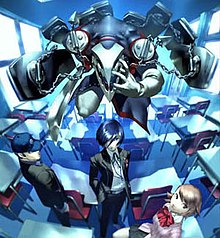
Two male and one female student stand in a classroom.  Behind and above the Protagonist, who stands at the center, is the Persona Thantos, a humanoid demon with eight coffins attached to its body via chains.
Persona 3 has two types of gameplay: the social mode during the day, where you can go to school,socialise with your classmates, take part in clubs ect. and there is also the dark hour gameplay, where you use your Personas to fight monsters known as 'shadows'. You move to a fictional known as Iwatodai. You join a group known as SEES (Specialized Extracurricular Execution Squad), a group of students who investigate the Dark Hour, a secret hour that takes place before 12AM. During the dark hour, you're able to explore Tartarus, a tower that contains Shadows, creatures that feed off the mind of humans. 

Gameplay

The gameplay uses a turned based JRPG battle system, but contains a twist common with the Shin Megami Tensei series; the turn press system, which gives you another chance to attack if you find the enemy's weakness. As you progress through the game, you're able to fuse/gain more Personas to fight enemies that will get stronger. There are also bosses in Tartarus, which can be difficult to battle. Very difficult. Some don't have weaknesses, and you'll have to rely your luck to get critical hits. When all of the shadows are weakened, you're able to do an All Out Attack, a skill where everyone in your party attacks all enemies at once. The gameplay does have flaws however, such as how you're only able to control the protagonist during battles, instead of the entire party. This can lead to party members not doing what you want them to do, and can sometimes make you fail in battle. Another gameplay flaw is the fatigue system. Staying in Tartarus for too long can make characters tired, which will make them not preform as well in battle.


Story & Characters

The story in Persona 3 is, in my opinion, one of the greatest stories of all time. It's not easy to talk about without mentioning spoilers. The characters are also well written too. They feel the most realistic in the series, as you can tell that at times they don't want to work together, but are forced to. The story pulls many twists with events and characters.